
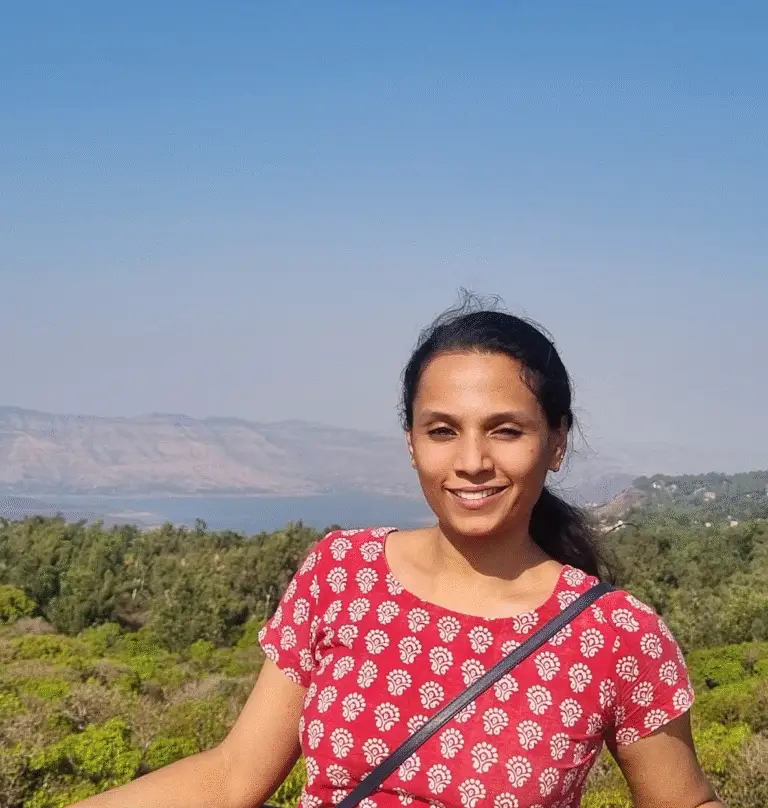
My parents come from different cultural backgrounds, and I was brought up in army cantonments. So culturally I identify as an ‘army kid’, rather than through a region-based or religious identity. And to add to the chaos, I am now married to a Malayali.
While I wouldn’t call myself a strongly ambitious person, my career has always been central to my life, I see it as a way to engage with the world (and, of course, to put bread/roti/rice on the table).
I recognise that my privilege has let me treat life and career as one consolidated thing, and there has been a constant ‘seeking’ running through it; one that has led to many impulsive decisions and detours, for better or for worse. I began at a rural livelihoods development NGO, then moved through a monitoring & evaluation consultancy, a peer-to-peer lending platform, a life-skills education non-profit, a for-profit ed-tech startup, and a corporate L&D startup, before starting up on my own in healthcare, where I’m currently pivoting to other opportunities.
Location: Pune
Linkedin: https://www.linkedin.com/in/preksha-sirsikar/
Write on: preksha@healthydialogue.in
Q. Tell us about your School and College before you came to IIFM. How was your experience there? And how did IIFM happen?
A. I studied in about eight different schools across Haryana, J&K, Meghalaya and Maharashtra in my younger days. That meant new teachers, new premises and new friends every few years. I didn’t mind the frequent changes, it was simply an unquestioned reality of life. I always enjoyed studying and was a rather docile child, so I usually ended up as the teacher’s pet wherever I went. When it came to friends, I had to learn both how to make new ones and how to leave others behind each time my father was posted out. These traits helped me settle into new places quite readily.
My later years in academics, however, were fraught with confusion. I didn’t really understand how to apply myself, and I felt I couldn’t live up to my potential. This gave birth to what became a central quest in my life: to be able to express my potential. What that potential actually was remained an unanswered question, and what its expression might look like was equally unclear. Much of the seeking in my career has been along these two axes.
I did my undergraduate in computer science, and someone at my MBA coaching centre suggested I fill out the form for a college like IIFM. I had no idea what IIFM was, but I filled it up and that’s where I landed. It turned out to be a very interesting turn in my life, because IIFM gives you the room to be adventurous in your career. It also exposes you to truths that, for most people, remain invisible or simply unavailable. In that sense, IIFM was an Easter egg in my journey 😊
Q. How has been your journey from IIFM so far?
A. My journey since IIFM has been quite interesting. Right at the start, I got to work with the government as part of a book writing project, and then at the grassroots in a very small block in the Bundelkhand region of Madhya Pradesh, which exposed me to two very different layers of reality at once. By the end of that stint, though, I felt I wanted to do something of my own. What exactly, I had no idea, so I took a few months off. During that break I realised I had absolutely no clue how to start up on my own, so I took up a job again, this time in business development at M&E consultancy. It wasn’t my core interest, but research always was, and I managed to combine the two. It was a short but very interesting and happy stint.
After that I got married and moved to Bangalore, where I serendipitously landed at a peer-to-peer lending non-profit. That was my first real exposure to the use of technology in the non-profit space, and it opened my eyes to how much we could do with it. We then moved to Hyderabad, and I took another break to give my entrepreneurial ambitions a shot. Around this time I was selected for a year-long startup programme at IIM Bangalore. It was here that I developed a deep interest in education, drawn both from my own experience of life and from what I saw around me in society. For the first time, I felt I had found a genuine passion in my career.
The startup I was working on didn’t work out, but I went on to join a non-profit where, in 2020, I built a WhatsApp-based life-skills education programme with UNICEF. This gave me the confidence that I could work with technology myself, even though I’d never formally practised it and while also making my limitations glaringly visible. Wanting to understand the education space better, I then joined a for-profit ed-tech company. It was a short but fascinating stint that exposed me to India’s startup culture; the hustle, the speed, and a founder mindset that was entirely new to me, coming from the non-profit world. It was an acerbic environment, but there was a great deal to learn there: how to get things done in the real world, how to experiment fast and fail fast, and how to build things from scratch in a very resource-crunched way.
From there I moved to a corporate L&D startup, which was different again; a more corporate culture, shaped by the founders and the clients we worked with. It gave me a window into how the L&D function works within corporate India, and I got to interact with a very different set of people, with very different needs, from those I’d worked with before.
Then I had my daughter, and I felt I needed more time with her and more freedom. It struck me as the right moment to pursue my entrepreneurial journey once more. My husband was starting up around the same time, so I thought we might as well be crazy enough to collaborate with no steady income, a little daughter, and all our eggs in one basket!
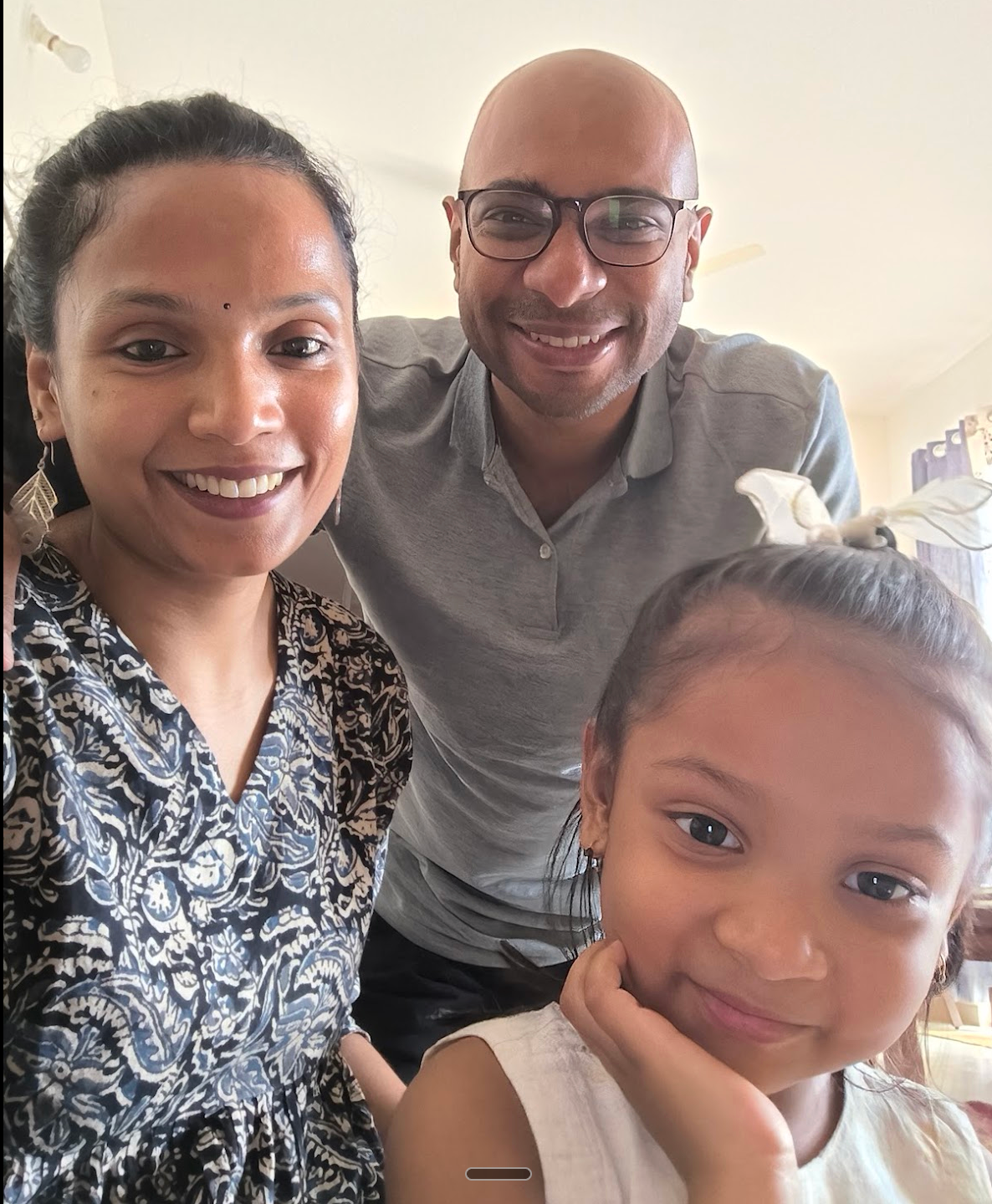 Our Family
Q. What were some of the key milestones/learning in this journey that you would like to share with us?
A. I feel I’ve been rather starved for external validation through my career, but a few bright spots come to mind: the publication of a book I contributed to in my very first project; our life-skills project winning the UNICEF Office of Innovation grant; and closing the first deal in my own startup.
The biggest learning for me has been about breaks. I’ve taken many of them over the years. People are often wary of stepping away because it’s frightening: what if you don’t get something back? What I’ve realised is that if you’ve built the basic skill sets; a genuine interest in quality, in learning, in doing a good job, and in being responsible to the people you work with, you can learn a great deal, and quickly.
There is, of course, real merit in compounding your skills over time within a single field. But for anyone inclined to be a generalist, it’s entirely possible to enter new sectors and establish yourself relatively quickly. Jumping from one area to another needn’t be as scary as it seems.
Q. How has been your experience in your current Organization? What all areas have you been working here?
A. Working for yourself is a peculiar challenge: you have all the freedom in the world but no structure, so you have to build that structure yourself. On the whole, the experience has been good, especially for the creative freedom it allows.
We work in the healthcare space. We started with the idea of improving the patient experience: essentially, empowering patients with the right information at the right time and supporting them through their treatment journeys, all within the constraints of the limited time a doctor has. We’re currently pivoting, because our experience has taught us that the product we began with may be a little early for the market. We’re now working with a few partners to build something else for the doctor universe.
Alongside this, we’re building AI automations for enterprise workflows and I’m in the middle of taking this to the development sector as well, because I believe the product we’ve created has real potential there. More broadly, I’m keen to collaborate with people to bring AI into the development sector. From the conversations I’ve had, it’s clear that the use case for AI still isn’t well understood across many development organisations, and I feel that’s a space where I can genuinely contribute.
Q. What is the most satisfying part in your career?
A. The most satisfying part of my career has been the ability to move from one sector to another and establish myself as a useful part of each organisation. Doing that without a network, and often without prior knowledge; relying only on foundational skills and mindset; has given me a sense of confidence in myself. There’s a lot of value in those foundations, and discovering that has been immensely satisfying.
Q. Has your learning at IIFM helped in shaping how you approach your professional roles?
A. I’d generally consider myself an empath, but what IIFM gave me was the chance to see parts of our society that would otherwise have been completely out of my reach. That has helped me empathise with people across the socio-economic spectrum, not only the most disadvantaged, but also, say, the person working at the block level within a government office, or those from marginalised communities. Surprisingly, this capacity translates rather well in tech product development too!
Q. Who (or what) are the biggest influences or drivers in your careers? What would be your advice to freshers and IIFM graduates who are looking to choose similar sectors/roles.
A. My biggest influences have been my circumstances and my internal quest to find an expression of my human potential. Earlier, I tied my identity very tightly to my career, and that often led to deep internal angst. As I’ve grown older, I’ve come to see my career more as a gym – a place to exercise skills and mindsets and become a better person – rather than something that defines me.
To fresh graduates, I’d say: use your career to learn who you are, to develop yourself, and never stop being playful or taking risks. Your career takes up a huge chunk of your day, so don’t merely ‘adjust’ to it, engage with it and mould it to your benefit. And do learn financial prudence from your very first salary. Start investing, even if it’s just ₹5,000 a month; compounding, in general, is your friend – with money, with skills, with habits. Financial freedom is what gives you the wings to be a little more adventurous and to actually enjoy your career.
Q. How was your experience in formal learning opportunities post IIFM?
A. I was part of the 2018 cohort of the Women Startup Programme run by NSRCEL, the business incubator at IIM Bangalore. It was very interesting to be in a group of 100 women entrepreneurs from across India, the ambition and the spirit of this lot was inspiring. I also got exposed to a lot of ideas about how to think through starting up and what that journey entails.
Besides this, I have also done a 100 hour course learning to be a coach. It was a unique experience. The course develops our ability to listen to others, without giving into the urge of offering solutions, but helping the coachee think through their own problems.
Q. What are your favorite memories during your IIFM days?
A. I remember the jungle area with a lot of fondness, Van Vihar and the bird-watching, and the field trips we were lucky enough to go on: fully planned, on-the-house adventures, I’d say!
Q. In hindsight, what was the biggest contribution or take away from IIFM that you think played a critical role in shaping you as an individual or professional?
A. The one thing I attribute wholly to IIFM is the exposure it gave me to a side of India I was completely unaware of. IIFM offers a beautiful gift – the chance to expand our limited consciousness – and our lives remain the richer for it, forever.
Q. The best buddies / seniors /faculty at IIFM? Some memorable tidbits that you like to share?
A. Arpana Tirkey – my roommate and an instant connection! She has always been the kindest, most loving friend, and my respect for her has only grown over the years as I’ve watched her life unfold. I also spent lovely times with Isha, and I remember Lubina very fondly. I have a warm friendship with Kiran KP (it was on his wedding trip that I met my now-husband) and one that’s grown over the years with Ramanshu. I’d love to rekindle connections with others from my batch too (please do reach out!).
Among the faculty, I remember Prof. CVRS‘s kindness in my very first days at IIFM. It was day three of orientation when I received the news that my beloved pet dog had passed away. I was inconsolable, crying on the stairs of the Acad Block, and CVRS Sir was so gentle when he found me like that. And Prof. Advait is now more a friend than a professor, he’s been kind enough to stay in touch through all these years.
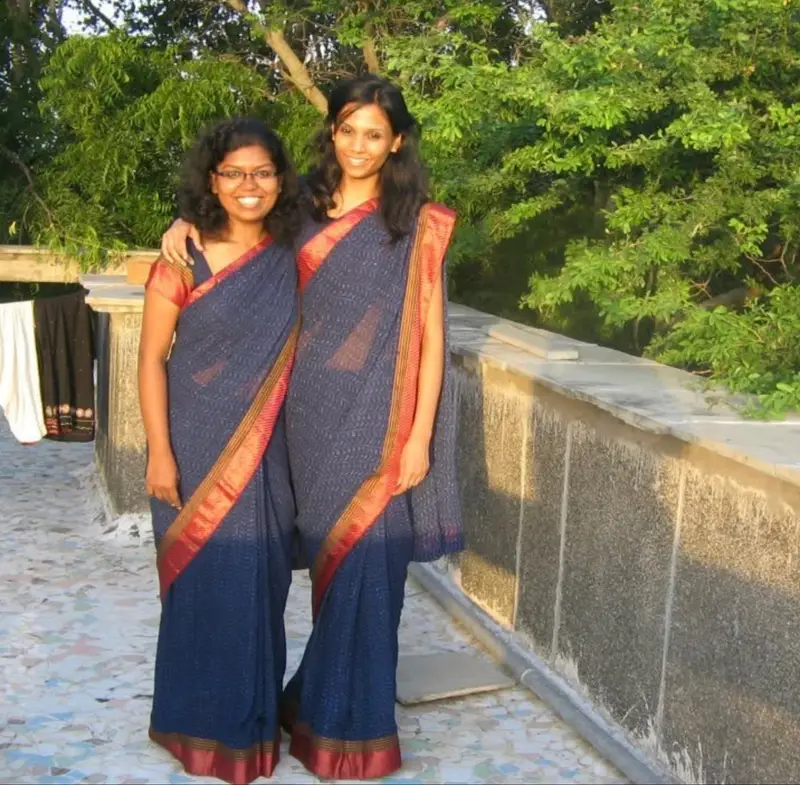 With Arpana on the roof of our IIFM hostel
Q. As an alumni, what’s your advice to freshers or those are joining IIFM to get best out of the 2 years there?
A. Be productive, build your skills, and explore who you are. In these early days of adulthood, it’s so important to explore almost aimlessly, so that you might stumble upon something you truly love. Take care of your health – educate yourself about nutrition and exercise, and do your best to build your body; it will hold you in good stead. Take care of your mind too – read and engage with content that nourishes you.
Above all, ENGAGE with whatever you do. Don’t blame professors if you don’t understand something in their lectures; keep your agency with yourself and learn off the internet if you have to. Self-learning is the key skill to build anyway.
Q. What would be your advise for recent graduates who look for changing their sector after working for couple of years?
A. Don’t worry! Take the leap – bindass. Apart from deeply technical skills, most of what we build is transferable. The one thing you must hold on to is a genuine keenness to learn. Learning is, by definition, a painful process, but it’s also deeply rewarding and builds a kind of self-confidence like nothing else. And apply to jobs in new sectors creatively: when I wanted to move into the education sector, of which I had no knowledge whatsoever, I got in by offering my services free for three months, simply because I wanted to work on that project. Once I’d worked with the team and effectively led that project, they offered me a role of their own accord.
Q. What is your typical day at the work? And how does it look like while you are on a break?
A. At the stage I’m at right now, the physical day looks like: designing products, testing them with customers, reaching out to potential collaborators and customers, pitching and communicating, analysing what’s working and what isn’t and making the hard calls to cull the things that don’t. The mental life looks like: constantly battling rejection but still living to fight another day; learning not to take things personally; dipping into creative reserves and trusting that you can pull something out even when you feel like you’re scraping the bottom; and holding your equanimity through both failure and success.
My interests besides work at the moment are studying Advaita Vedanta and maintaining a physically active life: yoga, strength training, and trekking whenever I get the opportunity. I’m feeling a strong pull towards watercolours lately, and I’m planning to take up a class to learn the medium. I also deeply enjoy listening to classical Hindustani music, and I’m lucky enough to catch live concerts quite often.
Q. IIFM is driven by alumni’s passion and commitments towards its goal. How would you like to contribute to IIFM or IIFM alumni, students? Your engagement with IIFM Placement or OT/SI?
A. I’m very open to collaborating with interested fresh graduates and current students. I’m not in a position to hire at the moment, but when the time comes, I’d love to work with talented people from our IIFM pool.
Q. What do you think is different at IIFM now vs when you studied there? When was the last time you visited IIFM?
A. The batch size and the infrastructure I guess is the biggest change!
And it has been a long time since I last visited IIFM in 2015/2016 so have to plan a trip soon 😊
Q. Any suggestions on who you want to get profiled/interviewed here?
A. Ramanshu Ganguly, Arpana Tirkey, Kiran KP