
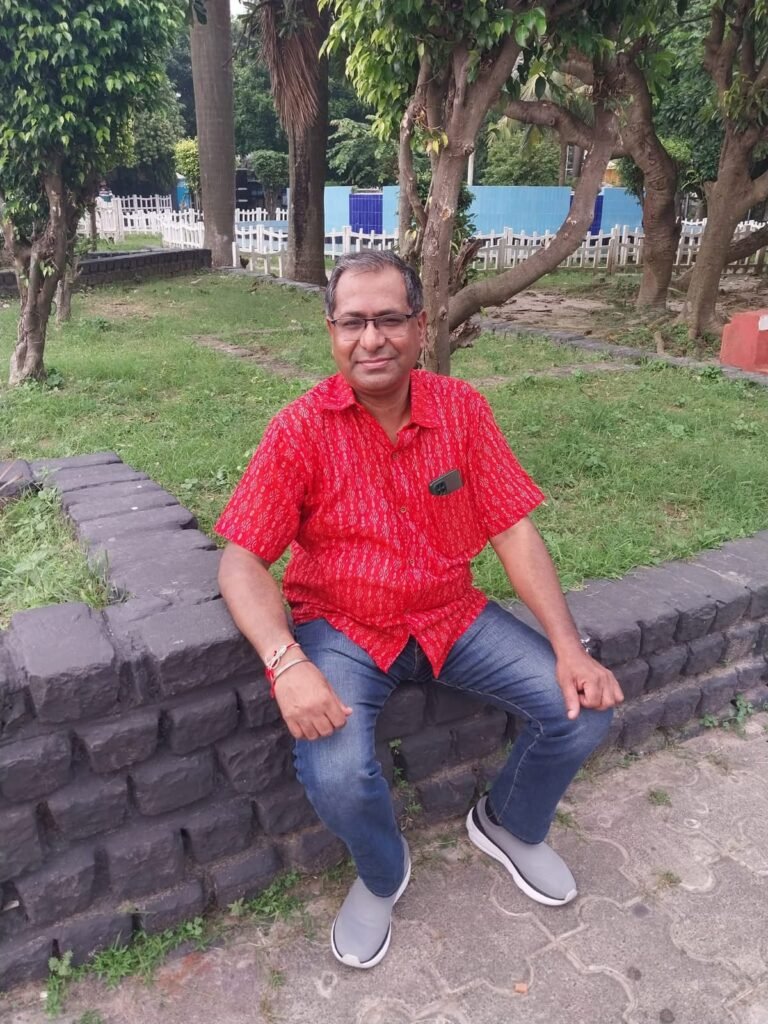
In the last 27 years, I had the opportunity of working in different capacities in Government agencies, a grassroots NGO, International not for profit organizations, bilateral projects and a development consulting firm. Since 2019, I have been working as an independent consultant. Almost all my work focuses on rural communities, largely in the domain of natural resource management. Having started with integrated watershed development, I have worked on microfinance, water (and sanitation), decentralization, sustainable agriculture, agricultural value chains, climate change adaptation, and most recently on climate induced migration and loss and damage research. I was fortunate to have worked across the country while also gaining limited international exposure.
Post IIFM, I have stayed in different cities- Shimla, Madurai, Bangalore and Hyderabad- while working across the country.
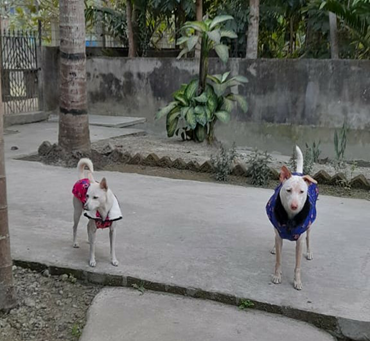
Since 2023, I stay in a village in West Bengal with my wife and two dogs. I have a daughter who has completed her Masters and currently lives away from home.
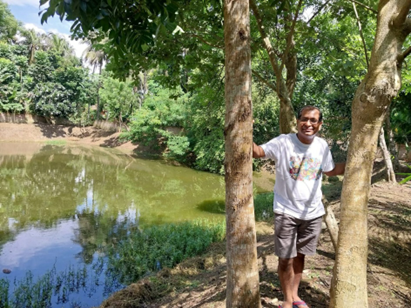
Location: A village near Maslandpur, North 24 Parganas, West Bengal.
Linkedin: Devanshu Chakravarti
Twitter: devanshu_c
Insta: devanshuchakravarti
FB: Devanshu Chakravarti
Q. Tell us about your School and College before you came to IIFM. How was your experience there? And how did IIFM happen?
A. I studied in a school in Shimla that recently completed its centenary celebrations in October 2025. The school has a rich legacy of contributing officers to the Indian armed forces. While inspired, I soon realized that I was not up to the physical demands of the service and after many a faltering at the engineering entrance exams, much to my parents’ relief, I got admitted to an agricultural engineering college in Jabalpur. I finished the course and spent a year of underemployment in a project at an agriculture University in Raipur. I learnt computer programming a skill I did not use henceforth! The saga of stumbling through entrances exams continued till a year after graduation, when much to my relief, I got admitted to IIFM, when a few of those in the first list did not want to enlist for the Class of PFM 1996-98.
Q. How has been your journey from IIFM so far?
A. It has been an extremely enriching journey so far. Let’s start at the very beginning. Much to the annoyance of some in my batch, I got placed as a young professional in a government agency working in rural development. Having spent most of my time in IIFM in the computer lab, these batchmates felt that I dd not deserve a job in the development sector. But that’s destiny!
I completed the two years contract with the organisation, mostly in Solan, placed with a Government agency and working on the newly launched integrated watershed management projects. I also worked with the Regional Centre Lucknow where I worked on appraising proposals and evaluating projects being funded to NGOs.
After finishing my contract, I went to work with a grassroots NGO in Madurai to learn about the dynamics of community based microfinance, much before this sub sector became an industry. I was anchoring monitoring and research. Here I learnt about the challenges faced by an organisation choosing to grow fast in a short period of time. I also learnt about microfinance and tank fed systems.
After marriage when I discovered that deficit financing was not a sustainable livelihood model, I changed jobs to join a bilateral watershed programme funded by the Swiss in Bangalore as an M&E specialist. I learnt about the challenges of implementing a bilateral project. In 2003, the Government of India asked many ‘small’ donors including the Swiss to withdraw project based funding. After the project closed in 2006, I was among two of the fifty odd staff working in project implementation roles in Swiss funded projects in India to become the core staff of a ‘Not for profit’ being setup in India by the Swiss NGO that was implementing the bilateral projects. I moved to Hyderabad in 2006 and stayed on till 2023, except for one year (2011-12) when I was in Delhi. In this organisation, in addition to implementing projects, I also got an opportunity to work on consulting assignments. I worked on climate change and agriculture value chains for the first time.
In 2011, to further learn about development consulting, I changed jobs to join a Delhi based consulting firm founded by an IIFMite, while being based in Hyderabad most of the time. I worked with Jayesh, Shailesh, Padmavati, Adavait Mahole and others to learnt in depth about consulting. I also realized that I have to learn new skills, especially in technology, from younger peers.
In response to feelers from my earlier organisation, I joined back the Not for profit in 2017 to shoulder higher responsibilities in the organization. Once the CEO changed, ideological differences on the nature of organisation growth become irreconcilable and I quit in 2019, to start my journey as an independent consultant.
Q. What were some of the key milestones/learning in this journey that you would like to share with us?
A. I am not very ambitious and hence never had any specific goals and career markers, so it is difficult to share milestones. As far as learning goes, it is a life- long continuum to stay relevant. We have to be open to learning from anyone who is an expert, be it a junior or a senior.
Q. How has been your experience in your current Organization? What all areas have you been working here?
A. I am working as an independent consultant since 2019. In this role, there is no assurance of a fixed salary cheque at the end of the month, so I must plan my budget annually and finances every quarter. While the income varies from year to year, they have been sufficient to put food on the table, educate my child, pay my EMIs and undertake the occasional indulges that go beyond necessity. For the last two years, I work closely with a London based independent policy and action research organisation where I report to an IIFMite. Currently I am providing mentoring support to research in different contexts for generating evidence on climate induced loss and damage.
Q. What is the most satisfying part in your career?
A. In Implementation projects- one feels satisfied when the impacts are visible with clear impact like improvement in productivity and incomes, increase in area under cultivation/ irrigation, etc.
For Consulting projects, once the project ends, it is difficult to know if the client used the inputs or kept it for later. Once I find out that they were useful, then it is satisfying.
During the initial stage of my career, unexpected appreciation from someone whom you looked upto was always a moral booster. In the current stage of my career, I feel it is satisfying to have the flexibility to choose your assignments, start your day when you want to and enjoy the work life balance.
Q. Has your learning at IIFM helped in shaping how you approach your professional roles?
A. The most important thing I learnt in IIFM was to be life long learner. Skilling and re-skilling periodically is important. While technical skills are important, it is also important to update on social, behavioral, technological and linguistic competencies from time to time.
Q. Who (or what) are the biggest influences or drivers in your careers? What would be your advice to freshers and IIFM graduates who are looking to choose similar sectors/roles.
A. My teachers and seniors/ mentors with whom I worked with during the early part of my career were, no doubt, big influences. However, I feel that life is also shaped by numerous ‘small influences’. Good advice also comes from friends, acquaintances and sometimes random strangers. We must listen attentively.
It is difficult to give generic advice as all individuals are unique and have different motivations. However, based on my experience, I share the following:
For freshers, I will advice not to start independent consulting right away. It is important to first learn the technical aspects, the business aspects, develop your network, discover what inspires you, and find your niche. It is important to get a good mentor who can guide you. It is also important to have peers with whom you can discuss and get honest feedback.
Those experienced and wanting to start on their own, please ensure you have sufficient liquidity to last at least a year or two, till the revenues stabilize. Please take the leap of faith only if you enjoy doing this. There will be times when there is no work and it is important to use this time productively.
Q. Did you think about going for higher studies post IIFM?
A. I did not go for higher studies post IIFM but I would highly recommend at least one international course for those who can pursue as I have learnt that this experience broadens perspectives.
Q. What are your favorite memories during your IIFM days?
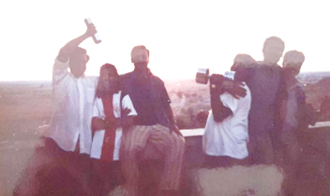
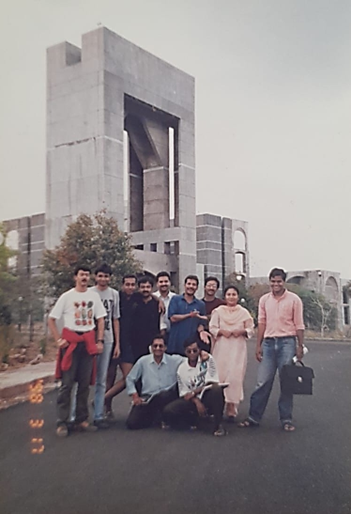
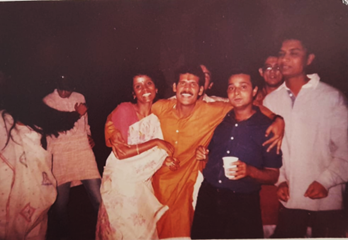
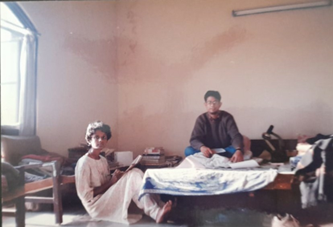
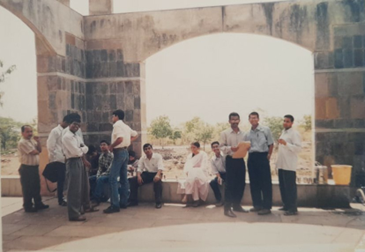
A. There are many happy memoirs from IIFM– the swanky rooms, the bad acoustics in the classrooms, the group work late in the night, the egrets in the morning, the cave paintings, the walk up the hills through the gate, the ‘mixed’ mess food of good days & bad days and the warm discussions, the birthday parties and the next morning hangovers, the scorpion bites, the occasional sighting of the caracal and the omnipresent monitor lizard, last minute photocopy of Bharti’s well organised notes, the organisation trainings(now called SI and WI), the field work, participation in forest games, the computer lab, the library…too many 🙂
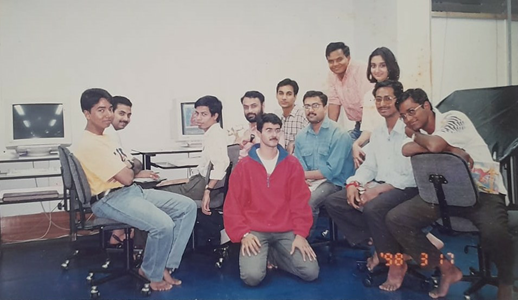
PC: Soumitri Das
Q. In hindsight, what was the biggest contribution or take away from IIFM that you think played a critical role in shaping you as an individual or professional?
A. IIFM has been quite central to my professional life. It is an identity that is known and respected in India. Being introduced as an IIFM graduate is helpful, especially in the initial stage of one’s career. However, for me, the association with IIFM has been helpful numerous times in my career. I got my first job during IIFM placements and then moved to an organisation from where I had done my organisation training as part of PFM. Whenever I wanted to change jobs, I sent my CV to people from my senior batch and got a job. When I started as an independent consultant, I got many assignments from organizations where IIFMites worked. So, IIFM is an important part of my professional career. Even today, I work closely with two IIFMites and also report to an IIFMite.
Q. The best buddies / seniors /faculty at IIFM? Some memorable tidbits that you like to share?
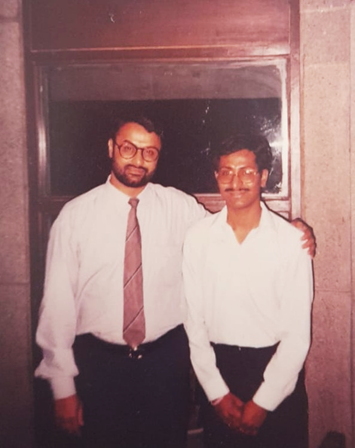
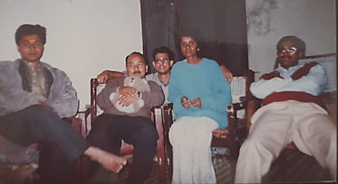
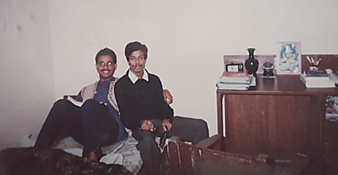
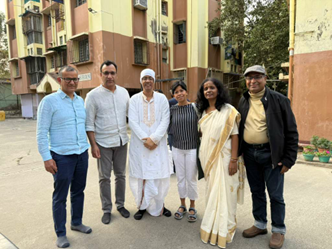
A. Our batch size was small- around 30 people, so we gelled well together. However, to name a few, I spent most of my time with Vivek Singh (my roommate), Rajeev Kumar, Rajiv Gupta, Shakeb Nabi, S RV Subhramaniam, Bhaskar Mittra, Soumitri Das, Shilpa Bahl (now Talwar) and others. From our senior batch, I spent time with Devesh Sharma, Prabhat Kumar Horo, Suneel Padale, Ashwini Saxena and Shailesh Nagar.
Dr. C. S. Rathore was the guide for both my organizational trainings and Dr. Mazumdar, IFS was my faculty guide. Post IIFM, I have met Dr. P. K. Biswas multiple times in Hyderabad. Twice I went to IIFM and at both times Dr. Amitabh Pandey was my first port of call. I also met Dr. Suprava Patnaik (twice) and Dr. Ram Prasad (once) briefly.
Tidbits- Let me share three, of the many-
1. During the first month in IIFM, few batchmates dropped out due to a variety of reasons- essential repeat in graduation, admission to a better institution, etc. There was a peculiar case where a student was asked to withdraw from the course as the authorities in IIFM felt that the equivalent marks in the under graduation were below the cut off. The student’s attempts to convince the authorities otherwise were all in vain. Coincidentally there was a party over the weekend where both students and faculty converged together. At the party, the student found a faculty who was the alumnus of his institute and shared his case-luck by chance! The faculty member immediately told the IIFM authorities that the student was right and that he will give a personal guarantee to this effect. After the party, we were chatting in our hostel room. The particular student with relief written large on his face shared pearls of wisdom “We have learnt our first lesson in management- More gets done in a party than in an office,”. Today that batchmate is settled abroad and is having a very successful career!
2. During the field work, we were attached to the Chhattisgarh forest department and travelled from one division to another. The first question asked in each division was related to the placements. Initially we were honest to share that students get placed in NGOs. Unhappy with the response that this answer elicited from the inquirer, we decided on a standard response “ First the placement is in NGOs, then after two years we move to UNDP and after another 2 years World Bank” and We suddenly graduated from ‘students’ to ‘Sir-Maam/s’ 🙂
3. After a post drinking dinner, when we reached the hostel, we found that a student was bitten by a scorpion and had been taken for treatment to a nursing home nearby. I, Shakeb and Devesh decided to go and see how we could support him. On the way down, a scorpion bit Devesh. Despite the pain he walked till we could get an auto and then went to the same clinic where our batchmate was being treated. Our batchmate was smiling while Devesh was squirming in pain. After treatment, while our batchmate slept soundly, Devesh shook uncontrollably throughout the night. The joke around the campus was that the attendant got a more severe bit by the scorpion than the original patient!!
Q. As an alumni, what’s your advice to freshers or those are joining IIFM to get best out of the 2 years there?
A. It is difficult for me to give advice to freshers as the context is very different from our times. We had to read books in the library, today students have google at their fingertips. We had to do assignments, today students use ChatGpt. With that disclaimer, let me share my thoughts for what its worth….do the basics right- study hard, do your assignments well, make good use of the facilities, pester the faculty with unresolved questions, use the alumni network to better understand opportunities, do the organizational trainings well, at the same time don’t miss out on the big picture…analyse the macro trends and most importantly don’t forget to enjoy the beautiful campus.
Q. What would be your advise for recent graduates who look for changing their sector after working for couple of years?
A. Change is the only constant in life. But it should not be ‘change for change’s sake’. The key questions to ask oneself are -why the change? What is the motivation for the change? What is the upside and what is the downside? How well prepared am I for the change? What are the mitigating factors? I think it is important to reflect critically and make an honest assessment before a change.
Q. What is your typical day at the work? And how does it look like while you are on a break?
A. As I do not have to go to an office that is outside the campus, I have flexibility of workdays and work hours. I take a break on Wednesday and Saturday. I start work late at around 11 am and the first thing I do is prepare a prioritized to do list. Then I keep working till I finish the list. I take a break every hour for around 10-15 minutes, when I go out and play with the dogs or take a walk around the pond.
Q. And how about weekends, hobbies, family and anything else you want to add?
A. I watch cricket and F1 religiously, weekend or no weekend. The day closes with news, some TV/ OTT.
Q. Favorite Books, movies, authors?
A. Authors: Keigo Higashino, Kazuo Ishiguro, Hari Shankar Parsai, Gabriel Garcia Marquez.
Movies: Jaane Bhi do Yaaron, Padosan, Kathal, Adolescence (OTT), The Gentleman (OTT).
Q. IIFM is driven by alumni’s passion and commitments towards its goal. How would you like to contribute to IIFM or IIFM alumni, students? Your engagement with IIFM Placement or OT/SI?
A. I work individually so cannot contribute to OT or SI, although I did pass on a lead and suggestions to Rishi. I am happy to contribute if given an assignment but in a supporting role. It is difficult to take a lead with my current work load.
Q. What do you think is different at IIFM now vs when you studied there? When was the last time you visited IIFM?
A. I visited IIFM in 2020 or 2021-during the pandemic. The campus was empty. From my earlier visit in 2018-19, I recall changes- the hostel is different now, there is a canteen. Everyone has laptops. It was different back then- computer lab and library were important places in the campus.
Q. Any suggestions on who you want to get profiled/interviewed here?
A. From my batch – Shakeb Nabi, Bhaskar Mittra, Rajeev Gupta, Rati Mehrotra, Sudipta Dasmohapatra, Shilpa Talwar, S RV Subhramaniam.
From my senior batch/es- Devesh Sharma, Ashwini Saxena, Prabhat kumar Horo, Amita Bhaduri, Nelson Royal, Dr. Sushil Sehgal, Jayesh Bhatia, Samrat Mukherjee.