
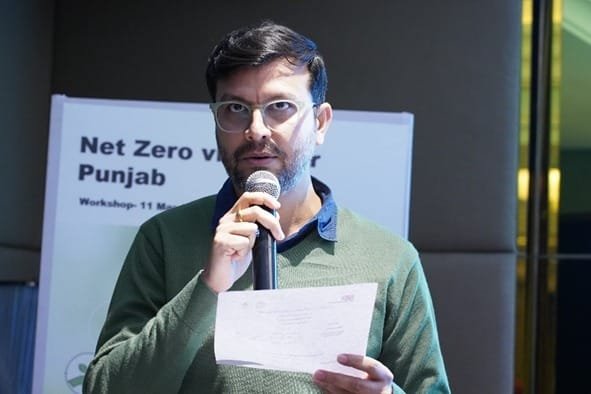
I consider myself fortunate to be working in the environment and sustainability sector, a space which calls for constant attention, intervention, skilled resource and real action. My journey since 2014 includes a diverse range of experience of working both within and with governments, civil society organizations, corporates and funding agencies across the climate change project management, implementation, grant making, government advisory and communications at subnational, national and global levels. I currently lead the Renewable Energy programme at NRDC India (a wholly owned subsidiary of Natural Resources Defense Council, a 50 year old global non-profit). Here my role involves managing programme delivery working with implementing partners, stakeholder engagement including governments (state and national), supporting regional strategy and external representation, to drive clean energy actions.
Location: New Delhi
Linkedin: https://www.linkedin.com/in/rana-pujari/
Twitter: @ranapujari
Q. Tell us about your School and College before you came to IIFM. How was your experience there? And how did IIFM happen?
A. I grew up in a suburban town, near Kolkata, called Rishra, on the banks of the Hooghly river. Did my schooling from Rishra and higher secondary (11th and 12th) from The Scottish Church Collegiate School, Kolkata. My childhood and school days are marked by making lifelong friendship, spending hours in outdoor games, falling in love with biology, and fighting my introvert’ ism. My inclination towards Biology took me to Amity University Noida in 2005 where I spend the next five years ‘trying to take interest in studies’ but focusing more on experiencing a whole new life called ‘Delhi’. Nothing worth mentioning about studies, but Noida/ Delhi years –
1. Made me more easy going and opened me up and
2. Gave me 3 bests of pals, well-wishers and jisko hum kehte hai ‘saccha yaar’ for the rest of my life.
IIFM was a very conscious decision when during 2009-10, I was still trying to find my way while continuously questioning myself ‘aage kya karna hai and what and where am I good at’? Continuing with a ‘not so exciting’ job in Kolkata, I started to read about environment, sustainability, renewable energy and potentially thinking about an MBA as my next move. I still remember a late-night chat (over gtalk) with my friend Basant (met him in Delhi) helped me discover IIFM as one of the potential campus for an MBA in the area of my interest. Well, that’s it and it was never looking back. I wrote CAT in 2011 and could secure a percentile enough to get a call from IIFM which fortunately I was able to convert. I won’t lie but IIFM was actually my top choice deep inside my heart.
Q. How has been your journey from IIFM so far?
A. With all excitement I had actually started writing about my experience in IIFM, but realized I mis-read the question!!
Journey post April 2014 has been interesting and satisfying as I got the chance to work with varied kinds of organizations, roles and people. I got hired by EPCO (for the State Knowledge Management Centre on Climate Change) from the campus which was a blessing since it meant my work location will be Bhopal. 18 months with EPCO was all about learning and absorbing, getting to know subnational climate governance up close, working closely with one of the renowned climate experts Mr Lokendra Thakkar.
I moved to Delhi in 2016 and since then am here having worked with reputed civil society and philanthropic organizations including the Shakti Sustainable Energy Foundation, Climate Group and now NRDC, with a brief stint with a Norwegian management consulting Xynteo too.
Every role gave me a new perspective of climate change discourse, policy making, role of stakeholders and witnessing how the narrative is evolving. So far so good, but lot is to be done. I am happy playing just a miniscule role in this universe of more relevant and credible actors.
Q. What were some of the key milestones/learning in this journey that you would like to share with us?
A. Professional life has been very simple and normal for me to be honest. There are no milestones worthy to be shared, but yes learning has been incredible, some of which I did allude to in the previous response. Few of my learnings so far are –
1. Always stay away from developing preconceived notions and judging without experiencing or knowing enough about something/someone
2. There is nothing called ‘one size fits all’ in the climate space – every challenge specific to a place, sector, geography, smallest unit of governance, community, etc etc is unique and needs to be dealt in a specific way
3. Respect every individual irrespective of their place in the organization hierarchy. Remember there is always someone who knows more than you, so accept and appreciate it.
4. Develop personal and long lasting connects with a select few whom you can trust and look up to. Meet people informally with warmth instead of feeling the pressure to be formal – Formality kills the chemistry and genuineness of any relationship.
5. Stay grounded, calm and take out time to periodically introspect around ‘what am I doing here? Is this worth doing? What is the end goal? Who is benefitting and who is being left out?
Q. How has been your experience in your current Organization? What all areas have you been working here?
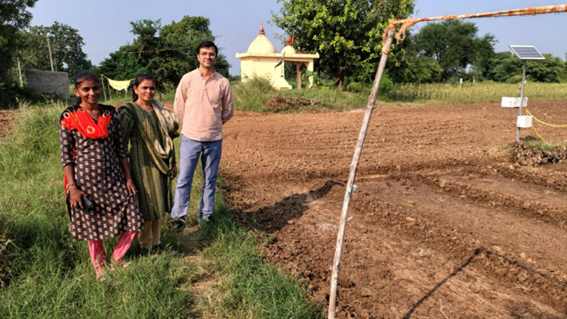
A. As I mentioned earlier, at NRDC India I lead the Renewable energy work and my role involves project management, partner engagement (including governments such as the Ministry of New and Renewable Energy (MNRE) and select state governments’ Nodal Agencies on Renewable Energy, SRLMS, etc), external engagement and strategic communications to regularly profile our work. I deeply value NRDC’s core values and the passion and ingenuity with which the international and country specific programs are responding to the climate crisis. My work in renewable energy is at the intersection of local climate action and policy making. On one hand I manage a project on grassroot-level energy transition where women are the leading agents of change and on other hand, I regularly have policy-level engagement with MNRE around Decentralized Renewable Energy, Model Solar Villages, green hydrogen and clean jobs and skilling – the kind of combination I was looking for in my role.
Q. What is the most satisfying part in your career?
A. Not one part but my career so far has been a satisfying ‘package’ with opportunities to work across local, subnational, national and global climate discourse.
Q. Has your learning at IIFM helped in shaping how you approach your professional roles?
A. IIFM definitely shaped my thinking and views on life and nature making me more aware of environmental conservation, resource utilization and theory. But when we move out, the real game begins as we try to connect theory to practice and discover certain gaps which we are actually trained to fill. The courses that I studied as part of Environmental Management and the field visits, did inform my curiosity and eagerness to professionally contribute to the cause. The multi-dimensional nature of PGDFM does help in effectively using both, management specific and people centric aspects of the sectoral work.
In my personal opinion, the well-spaced and not so rigorous two-year PGDFM has also instilled a sense of calm and thoughtfulness in my approach while also understanding the value of ‘taking a pause’ in life (both personal and professional).
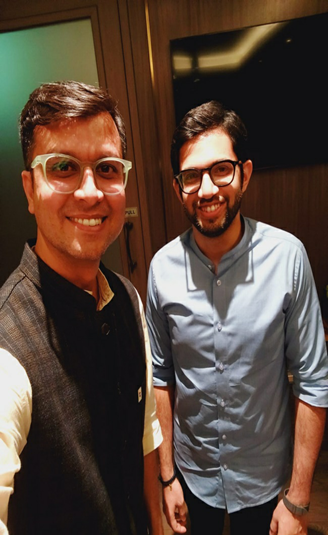 Good pals now, once worked together to drive Maharashtra’s climate ambitions during 2021-23. With Aaditya Thackeray, Former Environment Minister, Govt of Maharashtra
Q. Who (or what) are the biggest influences or drivers in your careers? What would be your advice to freshers and IIFM graduates who are looking to choose similar sectors/roles.
A. It is difficult to pick one or two names since there are quite a few. But one moment will always remain etched in my memory is the interaction we had with Mr Jadav Payeng, also known as the ‘Forest man of India’, during one of the events in IIFM. His simple character and the courage and determination to singlehandedly turn acres of land into forest in Assam can never equal any achievement, policy decision or action in the environmental conservation space. Go read about him, if you haven’t yet. PS: I got another chance to spend a day with him during a workshop we had invited him to in Meghalaya in August 2024. See pic below.
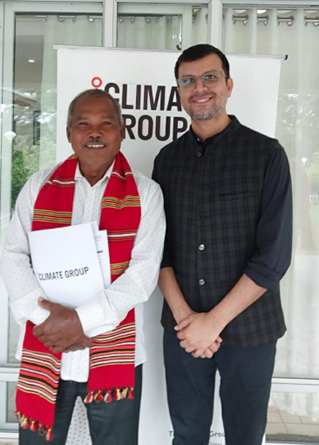 With a wonderful person & an Inspiration for many: Mr Jadav Payeng
Frankly I have achieved nothing to be advising others. Everyone will have their own journey and write their story but okay, very briefly – stay true to your ambition and the cause you really care for, do not hessite to ask difficult questions (believe me no question is difficult, it’s only the ‘mahaul’ that makes it), keep meeting people (I do at times to learn, validate my views, get inspired or just to have a cup of chai/ pint of beer), go to the field and interact with the community. Trust me, in the environment sector, it will be very easy to get demotivated and feel low even few months or years down the line since the impacts of climate change is so visible and at our door steps. You will feel what are we ultimately doing to solve it, where are the actions! But my earnest request will be – ‘Have patience and keep at it!’ If you are determined and have decided to work for this cause, success will take time. Individual success does matter, and I am not saying work for charity, but it’s our collective success (of community, society, industry, country or the world) that will ultimately matter since climate change is border neutral. Reminding yourself about this once a while does help calm the nerves! But take it easy (my IIFM mantra) 😊!
Q. What are your favorite memories during your IIFM days?
A. Every Friday (at least in the first two trimesters) a group of around 8/10 of us partying in hostel, numerous moments during the two field visits and goes without saying – finding Supriya, my one and only wife😊. But we never compromised on specializations – I chose Environment and she went for Development Management (lol). And we finally met for togetherness forever to get married in December 2016😊.
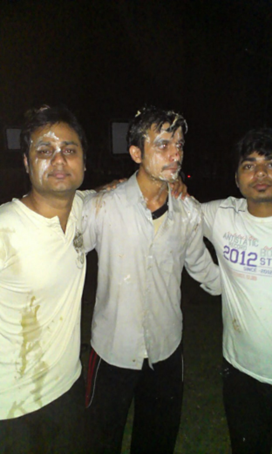 Treated with love on my first birthday in IIFM. In this photo with batchmates Brij Miholia (left) and Deepak Kumar ( right)
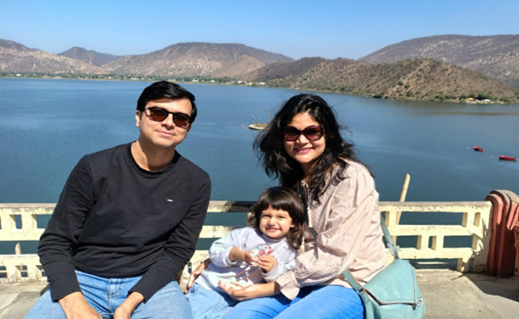 With Supriya and our daughter Vaanya in Alwar, Feb 2025
Q. The best buddies / seniors /faculty at IIFM? Some memorable tidbits that you like to share?
A. No best buddies then but my friendship with a chosen few actually grew over years post IIFM. Respect for all but particularly was a fan of CSR Sir’s gentle way of delivery, Dharni Sir’s personality and easygoing yet powerful character (we now occasionally bond over sher – o shayari and ghazals), Madhu Ma’am demeanor, knowledge and advice on career and the way Amitabh Sir still meets with his students with friendliness and warmth. But I believe academics is one of the subsets of IIFM’s world. There is mess, our caretakers, the roads, the grassland, the lake, the hilltop views, the trails and other stuff. I did have a great time chatting for hours with Tiwari ji of hostel and Arun bhaiya of mess hearing stories from their long experience in IIFM.
Q. As an alumni, what’s your advice to freshers or those are joining IIFM to get best out of the 2 years there?
A. Enjoy the two years with your batchmates, see the lovely city of Bhopal, spend time with the faculties outside classroom and do not spend your time only in the library or computer center. Doing all this will definitely translate into more holistic and lifelong learning rather than only theoretical knowledge which I think should be the objective of an institution like IIFM.
I also urge to take time off, relax and not take life too seriously.
Q. What would be your advise for recent graduates who look for changing their sector after working for couple of years?
A. It is a personal choice and hence perfectly okay to do it. Life is too short to delve into these trivial matters but ultimate objective should be to be happy in whatever you do so having the urge to explore more and something new is not wrong. I myself have switched multiple jobs (not sector though) with the aim to explore something new, challenging, overcome the stagnation in a specific role and to build my professional profile with more diverse roles.
Q. IIFM is driven by alumni’s passion and commitments towards its goal. How would you like to contribute to IIFM or IIFM alumni, students? Your engagement with IIFM Placement or OT/SI?
A. So far never got the opportunity to support placements/ OT/ SI due to policies of organizations I have worked for, but I am always available to mentor and guide new and young graduates including IIFM aspirants, offering guest lectures, connecting students with potential job prospects/ introducing to platforms or people for career growth.
Q. What do you think is different at IIFM now vs when you studied there? When was the last time you visited IIFM?
A. Cannot comment on the difference question since I genuinely do not know. I last visited in September 2021 to just take a stroll of the campus with Supriya (remember?) and a non-IIFMite friend.